Mono over mix: our packaging update
Reducing plastic use is an important step – but where plastic is unavoidable, it’s just as crucial to keep it in the cycle. Here at KoRo, we’ve spent a long time tinkering, repurposing gym weights and enlarging labels to improve the recyclability of our Doypacks. Find out here why paper isn’t always the solution, what ‘mono-material’ actually means, and what gym weights have to do with anything.
We know that the debate surrounding plastic is complex – and that is precisely why we approach it with a nuanced perspective. In our blog post about large value packs, we use internal calculations for selected products to show just how much material we save. According to these figures, larger packs can require an average of 38% less packaging material per kilogramme of product compared to standard market sizes.
Our 3 point plan for improving our bags
For packaging to make it onto our shelves, it must meet our 3-point plan:
Check #1: the freshness bodyguard
Before we talk about disposal, we need to talk about the contents. Product protection is a key factor for the environment. A spoiled snack that ends up in the bin means the loss of valuable resources. As the cost of producing the food carries significant weight in the overall balance, functional packaging indirectly conserves important resources by preventing food waste. Plastic offers an excellent barrier against oxygen and moisture, ensuring your snacks arrive as crisp as when we sent them and remain fresh for a long time – which can help conserve resources.
2. The separation drama
Until now, our Doypacks (the convenient stand-up pouches) had an invisible weak point: they were made from a ‘composite’ of different plastic layers. You can imagine it like a pizza that’s stuck inseparably to the cardboard box. As the layers are fused together, sorting plants cannot separate them. The result: the packaging is almost impossible to recycle properly, and is often incinerated.
3. All from a single mould
The solution to this problem is called monomaterial (in our case, PE). This means: The bag is now made from just a single type of material. It is optimised for recycling, as it is recognised and sorted by modern recycling plants and can thus be recycled into new products under suitable conditions.
Why didn’t we opt for monomaterials from the start? Composite materials made from different types of plastic were long the industry standard for optimal product protection. It is only thanks to technological advances and internal test series that we are now able to switch to a single material without compromising durability in line with our quality standards.
The way to mono material packaging: Step by step
There is far more to new packaging than just a new design. From the initial go-ahead to the first finished product on the shelf, we spent almost two years refining the optimal solution. To ensure your snack remains safely protected whilst still allowing the packaging to be recycled, we went through the process in several stages:
Here are the biggest milestones on our journey:
- The starting point: We began by searching for suppliers. Initial tests with 87% monomaterial showed we were on the right track, but not quite there yet.
- Expert power & reality check: Our packaging engineer Vicky comes on board. Her initial analysis: 87% monomaterial isn’t enough for us. Although just 70% monomaterial will be required from 2030, as up to 95% will be required from 2040, we opt for a future-proof solution.
- Meetings & stress tests: We bring all departments – from quality management and product development to design – together around one table. This is followed by intensive stress tests (more on this in the next chapter), filling trials and the search for the ideal seal.
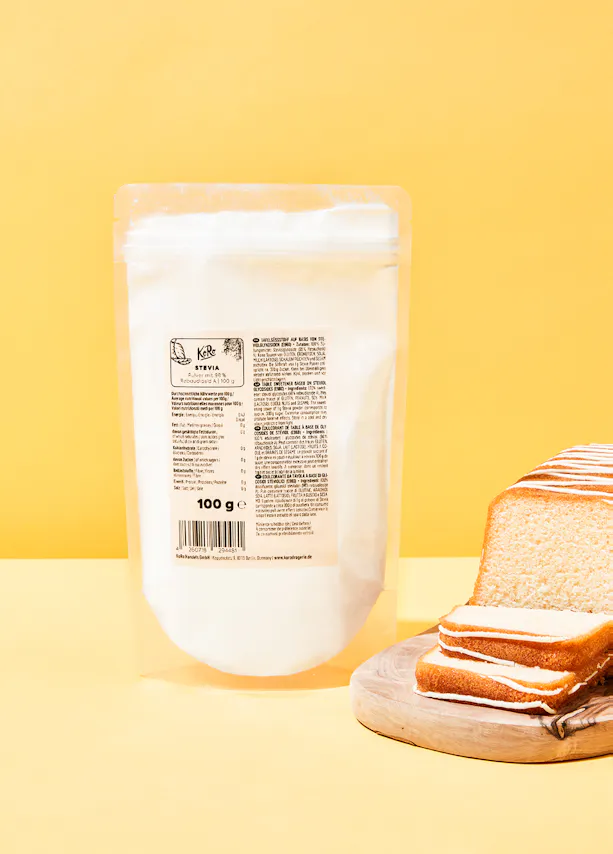
- The prototype is born! After almost two years of preparation, the time has come: our first product – Stevia – is successfully filled into the new mono-doypack.
50 kg vs. bag: the KoRo packaging test olympics
A new bag has to withstand quite a lot before it’s allowed to reach you with its precious contents. After all, your snack should arrive in one piece even if things get a bit rough at the courier service. To ensure that the bags don’t open and precious snacks don’t escape, our sealed seams have to prove their mettle. We decided to put them through their paces by loading them with 50 kg gym weights. The result? Passed! The seam held up.
Another discipline in the KoRo Packaging Test Olympics: the drop test. We carried out drop tests to ensure the pouches don’t burst during transport.
You may notice that the new Mono Doypacks look a bit ‘milkier’ and feel more flexible than the old ones. This is down to the PE material. In addition, a new bottom fold (the so-called K-Seal) ensures that the bag stands sturdily despite the softer material.
The label dilemma: Why size matters
We want to save on materials – yet our labels are actually getting bigger. What? Why? We’ll explain the reasoning behind this apparent contradiction.
Regulation vs. design: Regulations stipulate that all key information must be printed in a font size that is easily legible (even for those without eagle eyes) – at least 6 pt.
No extra waste from outer packaging: There simply wasn’t enough space on our previous A7 labels for all the legal information. To avoid having to use additional outer packaging (such as a paper box), we’ve switched to A6.
Single-material right to the end: To ensure recycling still works with the label, it’s now made from the same material as the bag – namely PE. A paper label would disrupt the recycling process, but our Mono-Duo passes through the sorting plant together without any problems.
The roll-out: A packaging switch isn’t built in a day
You might be wondering: “When will I hold the first mono-material bag in my hands?” Reality check: It might take a while yet; Stevia will kick things off, with the other products following step by step. Because as much as we’d all like to switch over hundreds of products to Doypacks at once, unfortunately it doesn’t happen quite that quickly.
We’ve divided our range into ‘sensitive’ and ‘less sensitive’ products. Whilst Stevia kicked things off as a pilot project in January 2026, further products are now following that are less sensitive to even the slightest changes in barrier properties. For categories such as nuts or fruit, further laboratory tests are still pending to ensure that the shelf life and crunchiness remain exactly as you’ve come to expect from us.
The plan for 2026
- We are planning the roll-out for the first 10 products from the less sensitive categories.
- Certification: At the same time as we develop our new packaging, we are working with independent partners such as Interzero to have the recyclability of our new pouches officially certified. So, in future, look out for the ‘Made for Recycling’ logo on your packaging.
- Continuous improvement: We’re analysing the results of the lab tests and gradually switching further doypacks to the new monomaterial.
The conclusion: not perfect, but constantly improving
Admittedly: Two years’ work for a pouch that ends up looking a bit ‘milkier’ sounds like a lot of effort. But for us, it’s a huge milestone. We have proven that our seal seams can withstand 50kg of gym weights and that a label can be large enough to provide all the information without disrupting the recycling process. Switching our soypacks to a single material is not the finish line for us, but an important part of our journey towards packaging with improved recycling properties.